Consulting for Secure Software Development
Consulting, coaching and training for secure, standards-compliant and efficient processes, methods and tools in software development.
Request consultationMethods & frameworks
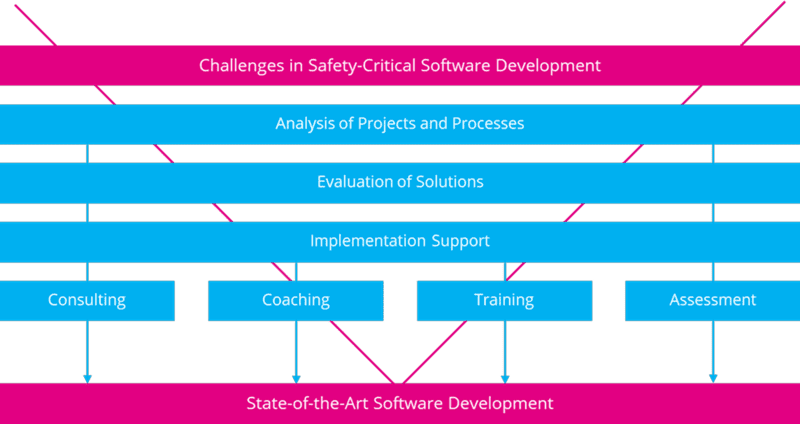
The development of safety-critical software is characterized by increasing complexity, regulatory requirements and OEM specifications. At the same time, there is often a lack of transparency regarding the actual maturity level of existing processes.
From analysis and optimization through to assessment, we support you in a structured and goal-oriented manner. We align your existing development processes with industry-specific standards, manufacturer-specific requirements and internationally recognized methodological frameworks, and evaluate them systematically. This enables you to identify improvement potential and implement precisely tailored measures that are not only compliant but also sustainably effective.
Our expertise

Automotive SPICE®
Automotive SPICE® is the established process and assessment model for the development of software and systems in the automotive industry. It defines reference processes and evaluation criteria that enable organizations to make their development processes measurable, comparable and systematically improvable. These processes range from requirements engineering through to testing. Automotive SPICE® is needed because OEMs and Tier 1 suppliers often require a verifiable level of maturity. In addition, standardized, auditable processes form the basis for reproducible quality, lower project risks, and supplier capability.

Functional safety
Functional safety in accordance with ISO 26262 is the established standard for managing safety risks arising from malfunctions of electrical and electronic (E/E) systems in vehicles. The standard defines a comprehensive safety lifecycle covering concept and development through to production, operation, and service, including the required methods, roles, and work products. A core element is a structured Hazard Analysis and Risk Assessment (HARA) with ASIL classification. Based on this analysis, safety goals as well as hardware and software safety requirements are derived and subsequently verified.

Cybersecurity
ISO/SAE 21434 is the standard for cybersecurity engineering in the automotive sector. It defines processes and evidence to consistently manage cybersecurity risks in systems, software, and the supply chain — from development to operation and updates. This enables organizations to meet customer and market requirements, create transparency regarding risks and ensure auditable compliance.

Additional services
In addition to our core focus areas, we support organizations in the organizational, methodological and standards-based advancement of their development processes:
Our service portfolio
We support organizations in the sustainable development of their processes and quality management practices.

Process Consulting
- Guiding software-intensive organizations in enhancing process maturity
- Improving and streamlining development processes
- Ensuring standards-compliant implementation of Automotive SPICE®, ISO 26262 and ISO 21434

Supplier Development & R&D
- Standards-compliant alignment of the R&D organization
- Conducting supplier assessments and readiness checks
- Implementation of manufacturer-specific requirements
- Deployment of SQIL (Software Quality Improvement Leader)

Software Project Management
- Program management
- Project leadership
- Coaching for project leaders and stakeholders

Operational Support
Providing experienced experts in operational roles such as
- Functional Safety Engineers / Manager
- Scrum Master
- Requirements Engineers
- Configuration Manager

Automotive SPICE® Assessments
- Formally recognized assessments according to Automotive SPICE®
- Including Cybersecurity, Mechanical Engineering and Hardware SPICE®

Gap Analyses
- Accurate baseline assessment through gap analyses (informal assessments)
- Structured action planning and process roadmap definition
- Integration of existing processes and structures
- Engagement of all relevant project stakeholders

Process Reviews
- Assessment of completeness, accuracy and practical suitability
- Evaluation against Automotive SPICE®, ISO 26262 and ISO 21434
- Verification of alignment with applicable standards

Potential Analyses
- Leveraging our experience with OEM requirements
- Evaluation and further development of suppliers
- Foundation for assessment and development in accordance with Automotive SPICE® guidelines
Industries with the Highest Requirements
Our services are designed for organizations operating in regulated and safety-critical industries. In these environments, software quality, functional safety and compliance are essential.
- Automotive: Safety-critical vehicle functions and connected systems require standards-compliant and stable development processes.
- Defense: Highly available and safety-relevant systems are subject to strict regulatory requirements.
- Medical Technology: Software with a direct impact on patient and user safety must be developed in a demonstrably safe and compliant manner.